CSIR-NEERI brings experts together to find solutions to air pollution
CSIR–National Environmental Engineering Research Institute (CSIR-NEERI) organised a Brainstorming Workshop on “Clean Air and Climate Resilience for the Indo-Gangetic Plains (IGP-CACR)” at its Delhi Regional Centre, Naraina, New Delhi.
CSIR–National Environmental Engineering Research Institute (CSIR-NEERI) organised a Brainstorming Workshop on “Clean Air and Climate Resilience for the Indo-Gangetic Plains (IGP-CACR)” at its Delhi Regional Centre, Naraina, New Delhi.
The workshop brought together scientists, policymakers and technical experts to identify practical, science-based solutions to air pollution in Delhi-NCR and the wider Indo-Gangetic Plains. Discussions covered airshed management, pollution sources, health impacts, climate vulnerability, pollution-control technologies, artificial intelligence-based decision-support systems and institutional partnerships. The focus was on solutions that can be implemented on a large scale and deliver measurable improvements in air quality.
The workshop was held under the leadership of Dr. S. Venkata Mohan, Director, CSIR-NEERI. It was attended by Dr. G. V. Raghunath Reddy, Scientist-F, Department of Science and Technology (DST); Dr. N. Subrahmanyam, Scientist-E, Ministry of Environment, Forest and Climate Change (MoEF&CC); and Dr. Balendra Singh, Scientist-D, Department of Biotechnology (DBT). Senior representatives from CSIR Headquarters included Dr. Shailaja Donempudi, Distinguished Scientist and Head, BDG and Dr. Anirban Pal, Scientist-G and Head, CPD.
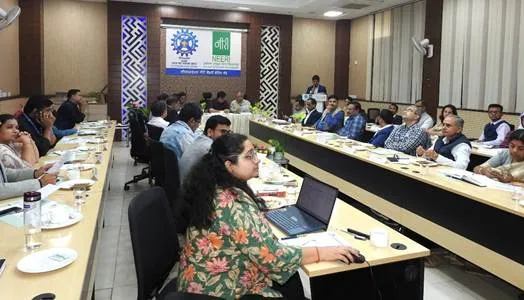
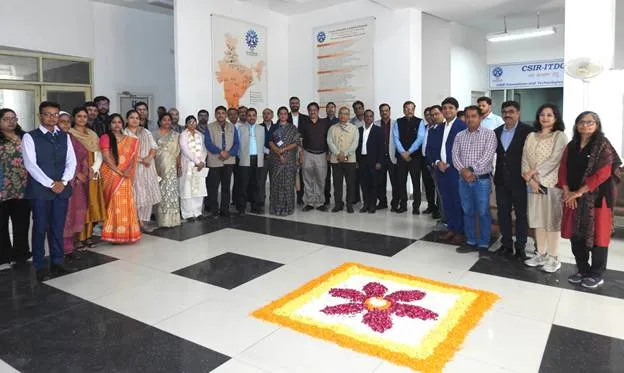
Participants from various ministries and CSIR institutions during the Brainstorming Workshop on “Clean Air and Climate Resilience for the Indo-Gangetic Plains” at CSIR-NEERI Delhi Regional Centre, New Delhi.
Dr. S. K. Goyal, Scientist-G and Chair, CSIR-NEERI Delhi Regional Centre, highlighted the major air pollution challenges in Delhi-NCR and Indo-Gangetic Plains. He stressed the need for coordinated airshed management, stronger air quality monitoring networks and an integrated PAN-CSIR mission to convert scientific findings into practical solutions and policy measures.
During the discussions, Dr. N. Subrahmanyam (MoEF&CC) emphasised the need to set up a technical committee for the Indo-Gangetic Plains to identify priority areas for action and develop a scientific approach for planning India's Continuous Ambient Air Quality Monitoring (CAAQM) network. Dr. Balendra Singh (DBT) highlighted emerging research opportunities in precision nutrition and human microbiome, particularly their links with health effects caused by air pollution. Dr. G. V. Raghunath Reddy (DST) suggested that CSIR prepare a structured list of potential interventions, identifying suitable locations and scales for their implementation to support demonstration projects.
Dr. Shailaja Donempudi, CSIR Headquarters, stressed the need to make greater use of CSIR technologies, particularly those that have reached Technology Readiness Level (TRL) 6 and above, through field demonstrations and wider deployment across the Indo-Gangetic Plains. Dr. Anirban Pal, CSIR Headquarters, highlighted the importance of developing technologies for specific pollution sources, along with clear implementation plans, defined institutional responsibilities and measurable outcomes.
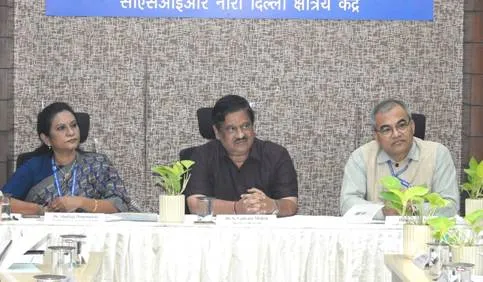
CSIR experts deliberating during the Brainstorming Workshop on “Clean Air and Climate Resilience for the Indo-Gangetic Plains”, organised by CSIR-NEERI at its Delhi Regional Centre, New Delhi
Scientists and experts from CSIR-NEERI's four Regional Centres at Delhi, Mumbai, Kolkata and Hyderabad and other CSIR laboratories and units actively participated in the workshop. These included CSIR-IIP, CSIR-CDRI, CSIR-IHBT, CSIR-IMTECH, CSIR-CRRI, CSIR-CBRI, CSIR-CMERI, CSIR-NIScPR and CSIR-NIDSA, along with CSIR's Traditional Knowledge Digital Library (TKDL) and Technology Management Directorate. The technical sessions were coordinated by Dr. Ankit Gupta, Scientist-E and Dr. Sunil Gulia, Scientist-D, CSIR-NEERI Delhi Regional Centre.
Highlighting the way forward, Dr. S. Venkata Mohan, Director, CSIR-NEERI stated that the institute would bring together the scientific and institutional recommendations from the workshop into a policy-level brief. The brief will identify priority interventions, technology readiness, potential demonstration projects and opportunities for collaboration. It will help support science-based decisions and coordinated action to improve air quality and strengthen climate resilience across Delhi-NCR and Indo-Gangetic Plains.
The workshop highlighted the need for a coordinated, science-based and action-oriented approach, moving beyond isolated measures to address recurring air pollution challenges and build climate resilience across the region.
Related Stories