ICAR and RIS Sign MoU to Strengthen Agricultural Cooperation and Knowledge Exchange Across the Global South
The Indian Council of Agricultural Research (ICAR) and the Research and Information System for Developing Countries (RIS) signed a Memorandum of Understanding (MoU) on 17 November 2026 at New Delhi to strengthen agricultural cooperation and knowledge exchange across countries of…
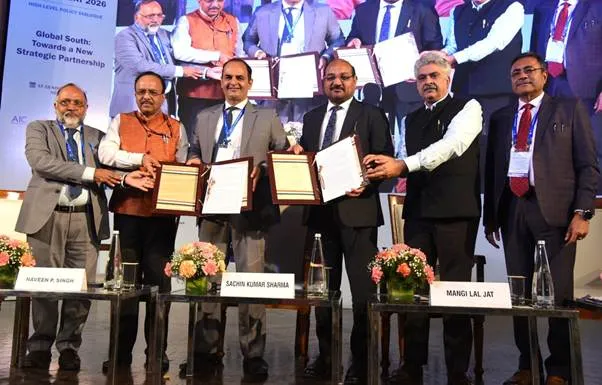
The Indian Council of Agricultural Research (ICAR) and the Research and Information System for Developing Countries (RIS) signed a Memorandum of Understanding (MoU) on 17 November 2026 at New Delhi to strengthen agricultural cooperation and knowledge exchange across countries of the Global South. The MoU was exchanged by Dr M. L. Jat, Secretary, Department of Agricultural Research and Education (DARE) and Director General, ICAR, and Prof. Sachin Kumar Sharma, Director General, RIS. The partnership, facilitated through DAKSHIN – Global South Centre of Excellence, will focus on sharing agricultural technologies, documenting best practices, knowledge exchange and capacity-building.
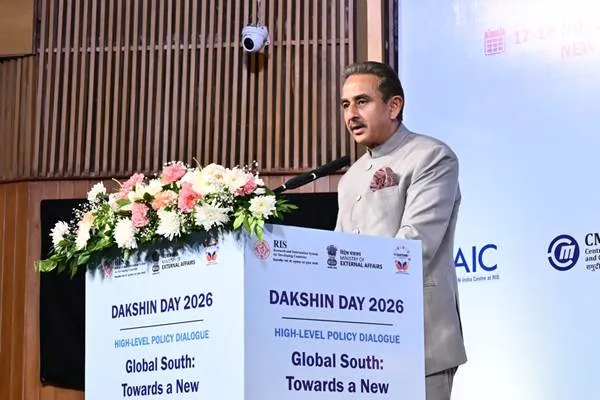
Speaking at the inaugural session of the High-Level Policy Dialogue on “Global South: Towards a New Strategic Partnership”, Shri Kirti Vardhan Singh, Minister of State for External Affairs, Government of India, emphasised that the Global South must strengthen its collective voice in shaping global narratives, building economic resilience and ensuring equitable access to emerging technologies, particularly Artificial Intelligence. He called for stronger India–Africa partnerships, greater institutional collaboration and active engagement of young researchers and policymakers in translating knowledge into meaningful policy outcomes.
Recalling the vision of Prime Minister Shri Narendra Modi at the Second Voice of the Global South Summit in November 2023, the Minister highlighted the importance of developing common perspectives on shared challenges, strengthening economic resilience and promoting affordable, scalable and locally relevant development solutions. He emphasised the need to move beyond traditional development cooperation towards co-development and shared solutions.
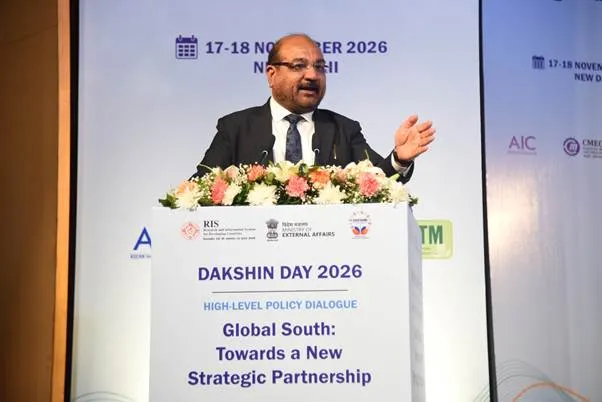
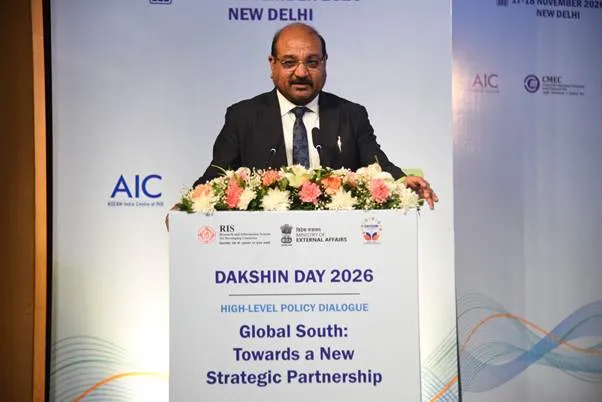
Dr M. L. Jat, Secretary, DARE and Director General, ICAR, highlighted ICAR's role as a century-old apex organisation for agricultural research, education and extension, with 114 research institutions, 152 regional research centres and 731 Krishi Vigyan Kendras (KVKs), while coordinating with nearly 80 agricultural universities. He informed that ICAR has 74 Memoranda of Understanding with different countries and institutions, of which nearly 60 per cent are with institutions from the Global South.
Dr Jat emphasised that the partnership with RIS and DAKSHIN would further strengthen South–South collaboration by facilitating the exchange and application of available agricultural technologies, practices, systems, methods and tools across countries. He also highlighted the importance of identifying suitable agro-climatic and research domains to connect countries. He mentioned the proposed Science and Partnership Week in mid-April 2027, which will bring together participants from the Global South and North in India, and the idea of convening Global South and North leaders to discuss their respective needs and available capabilities through demand-driven partnerships.
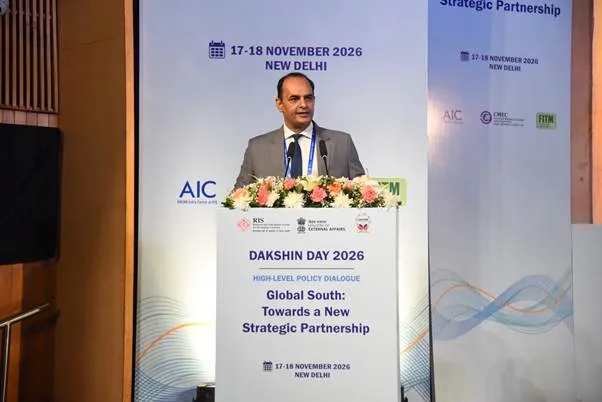
Prof. Sachin Kumar Sharma, Director General, RIS, highlighted the importance of agriculture for the Global South and the need for knowledge sharing, mutual learning and cooperation. Drawing upon his experience in agricultural negotiations at the World Trade Organization (WTO), he highlighted the need to strengthen the voice and concerns of Global South countries in multilateral negotiations and global decision-making. He noted that RIS has a strong network across the Global South, while ICAR brings extensive agricultural technologies, research and best practices. He emphasised that the partnership would facilitate the sharing of Indian technologies and practices with other countries, particularly those with similar agro-climatic conditions, while also enabling mutual learning from partner countries.
H.E. Prof. Anil Sooklal, High Commissioner of South Africa to India, described the present global uncertainty as a defining moment for the Global South to assert its leadership in shaping a multipolar world order. He called for reforms in global governance, stronger strategic partnerships and the generation of knowledge and policy perspectives from within the Global South.
H.E. Mr Alem Tsehaye Woldemariam, Ambassador of the State of Eritrea to India and Dean of the Diplomatic Corps in India, emphasised the importance of translating the historical solidarity between India and Africa into meaningful partnerships through economic cooperation, connectivity, infrastructure development and youth engagement.
Ms Archna Vyas, Country Director, Gates Foundation, India, identified Digital Public Infrastructure, health security, agriculture and food systems, Artificial Intelligence and institutional capacity-building as promising areas for India–Africa cooperation. She stressed that effective partnerships must be grounded in country ownership, co-creation and mutual learning, with a focus on affordable and scalable solutions.
Dr Rajan Sudesh Ratna, Coordinator, DAKSHIN – Global South Centre of Excellence, reaffirmed DAKSHIN's commitment to moving from dialogue to actionable partnerships through country-led priorities, institutional cooperation and capacity-building.
The MoU signing took place during the two-day High-Level Policy Dialogue organised by RIS–DAKSHIN in partnership with the Ministry of External Affairs, Government of India, on 17–18 November 2026 at the India Habitat Centre, New Delhi, on the occasion of DAKSHIN Day 2026. The dialogue brings together diplomats, policymakers, researchers, development practitioners and representatives of academic and partner institutions to deliberate on strengthening South–South cooperation, with particular emphasis on the evolving India–Africa strategic partnership. The collaboration between ICAR and RIS aims to promote the exchange of agricultural technologies, knowledge, best practices and capacity-building opportunities across the Global South.
Related Stories