Textlocal Has Shut Down in India. Here Is How Businesses Are Moving Their SMS, and Why SMSGatewayHub Is on the Shortlist
Textlocal's India platform was decommissioned on 31 October 2025, leaving OTP and alert SMS without a carrier. An auditor's checklist for choosing a replacement, what happens to your DLT registration, and how SMSGatewayHub measures up.
Textlocal's India SMS platform closed on 31 October 2025. Businesses keep their DLT entity, headers and templates, but must move to a new provider. We audit what to check and how SMSGatewayHub, which offers a simple API, DLT help and a free trial, compares.
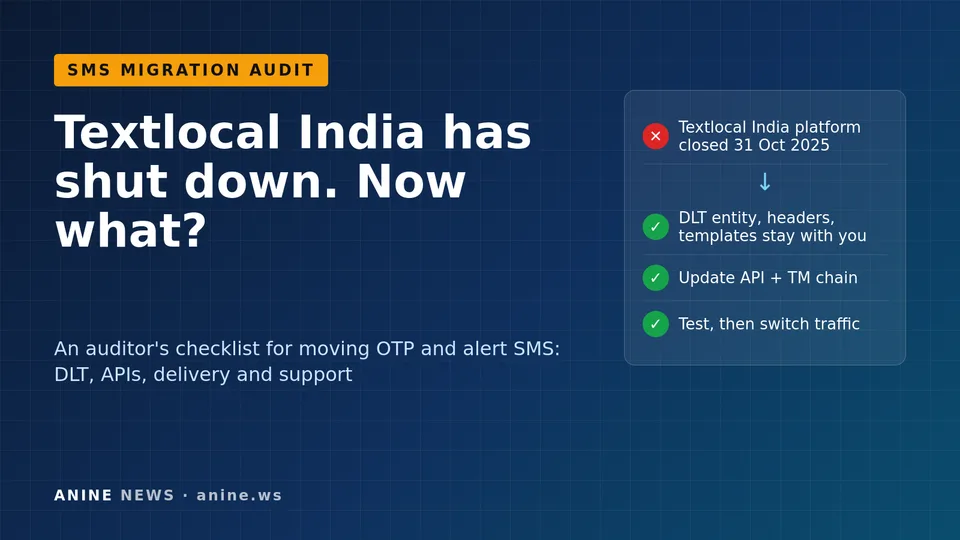
Quick answer: Textlocal's India platform was decommissioned on 31 October 2025, according to the company's official sunset notice. Account holders lost access to their accounts and could no longer send messages. Businesses that still had OTP, alert or marketing SMS running through Textlocal must move to another DLT-registered provider. Their DLT entity, sender IDs (headers) and templates stay with them, so the switch mainly means changing the API, adding the new provider to the DLT chain and testing delivery. SMSGatewayHub, an Indore-based provider operating since 2009, is one of the providers former Textlocal users are moving to. It offers a free trial to test delivery before buying.
Textlocal India shutdown at a glance
| What happened | Textlocal's India SMS platform was decommissioned |
| Date | 31 October 2025 (India). The wider Textlocal Messenger service later closed on 31 July 2026, according to Webex Interact. |
| Parent company | Textlocal became part of Cisco after Cisco bought its parent company, IMImobile, in 2021. Customers were pointed to Cisco's Webex Interact platform. |
| What users lost | Account access, message sending, and the old api.textlocal.in endpoints |
| What users keep | DLT entity ID, approved headers and content templates, which are registered on telecom operators' DLT portals, not with Textlocal |
| What to do | Pick a new DLT-registered provider, add it to your DLT chain, update your API calls and plugins, test, then move traffic |
What happened to Textlocal in India?
Textlocal was for years one of the best-known bulk SMS platforms in India, especially with small businesses, schools, clinics and developers who wanted a simple SMS API. After Cisco acquired IMImobile, Textlocal's parent, the service was gradually folded into Cisco's Webex Interact product.
Textlocal's official sunset notice says that, for India customers, "the platform was decommissioned on October 31st, 2025", and that users would no longer have access to their account or the ability to send messages. Earlier, new sign-ups had been stopped and customers were told to export data and plan a move. Webex Interact's own notice later said the remaining Textlocal Messenger service closed on 31 July 2026, with all messaging, APIs and proxy services stopped.
What does the shutdown mean for businesses?
For any business that still had Textlocal wired into a website, app or software, the effect is direct:
- OTP and login SMS stop. Customers cannot log in, verify phone numbers or complete payments that depend on an OTP.
- Alerts stop. Order, delivery, appointment, fee and bank-style alerts are not sent.
- Plugins fail quietly. WordPress, WooCommerce, CRM and billing plugins that used the Textlocal gateway keep "trying" but nothing is delivered.
- Reports and contact lists are gone if they were not exported before the account was closed.
Do you lose your DLT registration when a provider shuts down?
No. In India, every business that sends commercial SMS must register on a telecom operator's DLT (Distributed Ledger Technology) platform under TRAI rules. Your entity ID, your sender IDs (headers) and your approved message templates live on that DLT portal, in your name. They do not belong to the SMS provider.
What changes is the chain. TRAI now requires every message to be traceable from the business (the principal entity) through each telemarketer that carries it. So when you change provider, you must add the new provider's telemarketer ID to your chain on the DLT portal. A good provider will tell you exactly which ID to add and help you do it.
An auditor's checklist: how to judge a replacement SMS provider
When a supplier shuts down, the risk is rushing into the first cheap offer. These are the ten checks an auditor would run before signing:
- DLT readiness: Is the provider a registered telemarketer, and will they help update your DLT chain?
- API change effort: How much code must change? Is there clear documentation with sample code?
- OTP route and speed: Is there a separate priority route for OTPs, and what delivery time is claimed?
- Delivery reports: Can you see per-message delivery status by API and in the panel?
- Uptime evidence: Is there a public status page, not just an "uptime" banner?
- Security: Does the provider hold a recognised certification such as ISO 27001?
- Support: Is support available 24x7, by phone, with a named account manager?
- Pricing transparency: Are rates published? Are there setup fees? Do you pay for submitted or delivered SMS?
- Trial before buying: Can you test real delivery to your own numbers before paying?
- Other channels: If SMS fails, can the same account send WhatsApp, RCS, voice or email?
How does SMSGatewayHub measure up?
We ran SMSGatewayHub through the same checklist using the information on the company's website and developer documentation.
| Check | What SMSGatewayHub offers |
|---|---|
| Track record | In business since 2009, based in Indore; says it serves 10,000+ registered businesses and 2,000+ enterprise clients |
| DLT readiness | DLT-ready API with entity ID and template ID fields; a dedicated DLT support desk to help with registration and chain updates |
| API change effort | Simple HTTP GET/POST SendSMS API, plus JSON and XML; sample code in cURL, PHP, Python, Node.js and C#; Swagger and PDF references |
| OTP route | Priority OTP route on the same endpoint (channel=OTP); the company quotes 2–6 second delivery |
| Throughput | 200 requests per second as standard |
| Delivery reports | Delivery report API, balance API and webhooks |
| Uptime evidence | Public system status page; 99.9% uptime SLA stated |
| Security | ISO 27001 certified, according to the company |
| Support | 24x7 technical support, toll-free sales line 1800 102 1822, dedicated account manager |
| Pricing | Published price lists, zero setup fee, and billing for delivered SMS; bulk SMS starts at ₹0.12 per SMS on high-volume slabs |
| Trial | Free trial credits for new accounts, so delivery can be tested before buying |
| Other channels | WhatsApp Business API, RCS, voice, missed call, IVR/toll-free and email on the same account |
| Plugins | WordPress, WooCommerce and Excel plugins, and a desktop app |
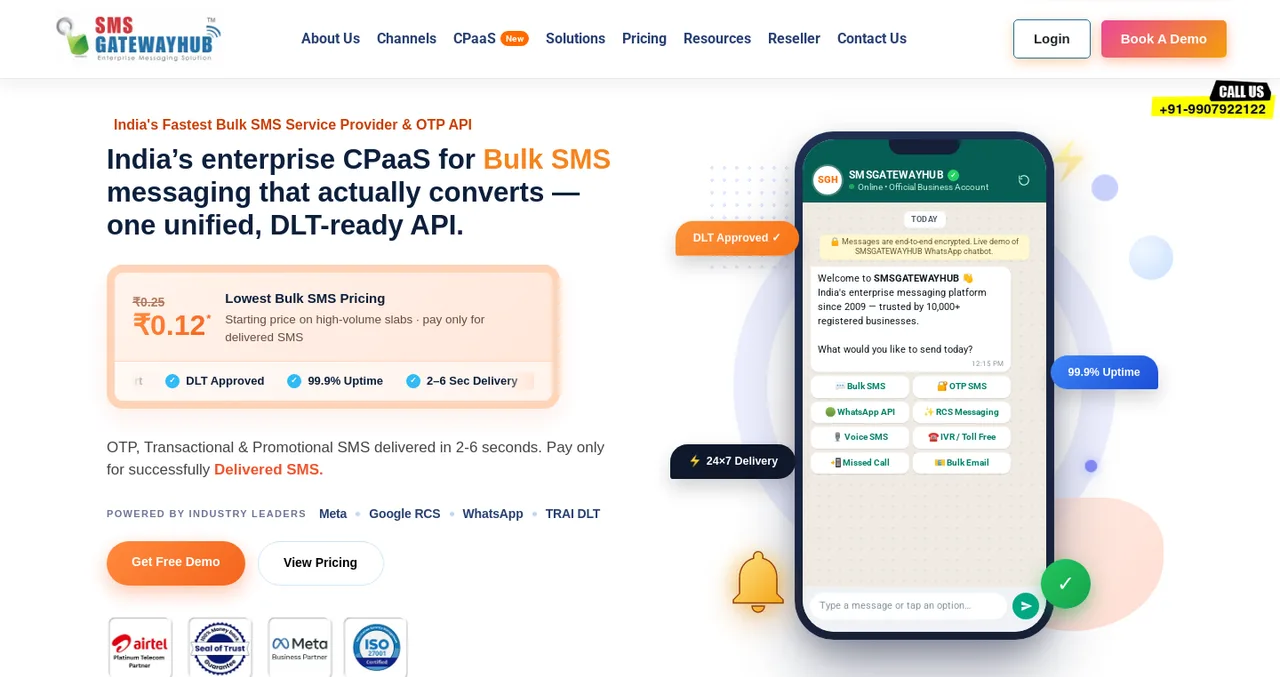
On paper, SMSGatewayHub ticks every box on the list. The points that matter most for a former Textlocal user are the DLT help, the simple API and the free trial, because together they make a low-risk switch possible: you can test real OTPs to your own phone before you move any live traffic.
Why are Textlocal users moving to SMSGatewayHub?
SMSGatewayHub says it has onboarded former Textlocal customers since the shutdown was announced. Three reasons stand out:
- The API works the same way. Like Textlocal, SMSGatewayHub uses a simple HTTP API: an API key, a sender ID, the mobile number and the message. Developers rename a few fields rather than rebuilding their integration.
- Migration help is hands-on. According to the company, its team helps with the DLT chain update, maps old Textlocal API calls to the new ones, sets up plugins and sender IDs, and tests the first messages with the customer.
- Try before you buy. Free trial credits let businesses check delivery speed on their own numbers before paying.
Moving your code from Textlocal to SMSGatewayHub
Most Textlocal integrations used a single "send" call. This is how its fields map to SMSGatewayHub's SendSMS API:
| Textlocal (old) | SMSGatewayHub (new) | Note |
|---|---|---|
apikey | APIKey | Copy from the new panel |
sender | senderid | Your same DLT-approved header |
numbers | number | Comma-separated, with country code 91 |
message | text | Must match your DLT template |
unicode=true | DCS=8 | For Hindi and other regional scripts; DCS=0 for English |
schedule_time | schedtime | Optional scheduling |
| (not needed) | channel, route | channel=2 for transactional, channel=OTP for OTP |
| (not needed) | EntityId, dlttemplateid | Your DLT entity ID and template ID |
A transactional send then looks like this:
https://www.smsgatewayhub.com/api/mt/SendSMS?APIKey=YOUR_API_KEY&senderid=ABCDEF&channel=2&DCS=0&flashsms=0&number=91XXXXXXXXXX&text=Your+OTP+is+482913&route=1&EntityId=YOUR_ENTITY_ID&dlttemplateid=YOUR_TEMPLATE_ID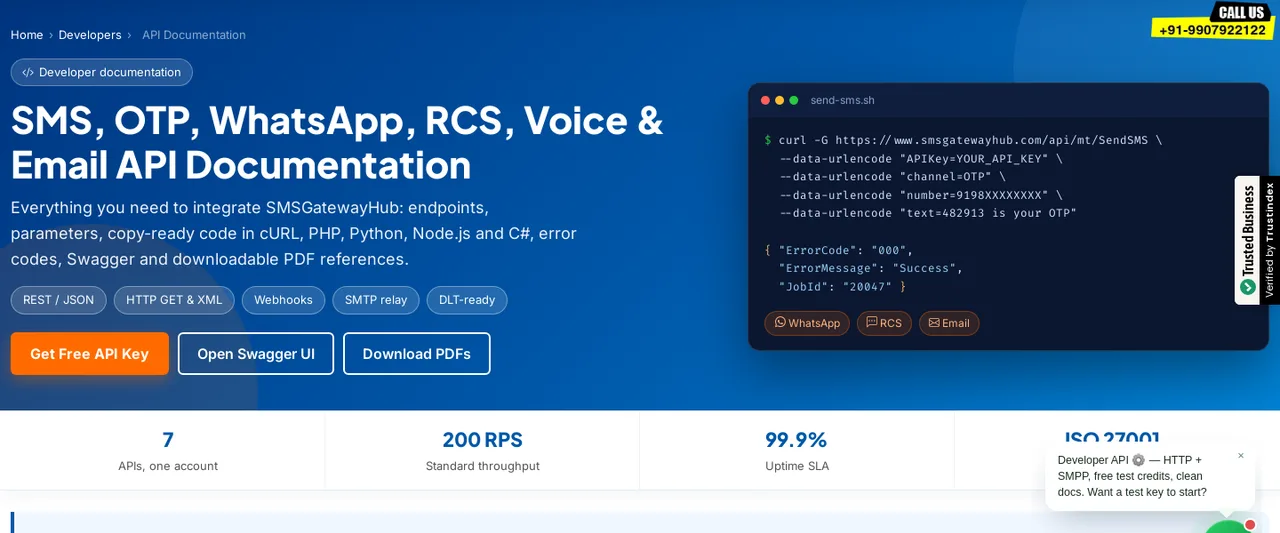
A 7-day migration plan
- Day 1 – Inventory: list every website, app, plugin and server that called api.textlocal.in.
- Day 1 – Sign up and test: open a new account and use the trial credits to send test SMS to your own numbers.
- Day 2 – DLT chain: log in to your DLT portal and add the new provider's telemarketer ID to your chain.
- Day 2 – Headers and templates: confirm the same headers and templates are mapped in the new panel.
- Day 3–4 – Code and plugins: update API calls using the field map above; switch WordPress/WooCommerce gateway settings.
- Day 5 – Test every template: OTP, alerts and any promotional templates, in English and regional languages.
- Day 6–7 – Go live and monitor: move traffic, watch delivery reports, and keep support on call for the first week.
How can a business try SMSGatewayHub before buying?
New accounts on SMSGatewayHub get free trial credits under a try-before-you-buy approach. Businesses can sign up, send test OTPs and alerts to their own phones, check delivery speed and reports, and then buy credits only if they are satisfied. Sales can be reached on toll-free 1800 102 1822, and technical and DLT support on +91 99079 22122.
Frequently asked questions
Has Textlocal shut down in India?
Yes. Textlocal's official notice says its India platform was decommissioned on 31 October 2025. Users can no longer log in or send messages.
What is the best Textlocal alternative in India?
Look for a DLT-registered provider with a simple API, a priority OTP route, delivery reports, 24x7 support and a free trial. SMSGatewayHub meets all of these and offers hands-on migration help for former Textlocal users.
Will my DLT headers and templates work with a new provider?
Yes. They are registered on the operator's DLT portal in your name. You only need to add the new provider's telemarketer ID to your DLT chain.
Is SMSGatewayHub's API the same as Textlocal's?
It works the same way, as a simple HTTP API with an API key, sender ID, number and message. The field names are different, so developers rename a few parameters (for example apikey to APIKey and message to text).
How long does it take to move from Textlocal?
For most small and mid-sized businesses, a few days to a week: one day to test, one day for the DLT chain, and a few days to update code and plugins.
Does SMSGatewayHub offer a free trial?
Yes. New accounts get free trial credits so businesses can test delivery before buying.
Related Stories